
Macro20d ago
EIA Crude Inventories Draw 0.4M vs Forecast 1.4M Draw
EIA crude inventories drew 0.4M for the week ending September 4, versus a 1.4M draw forecast and a 4.5M prior draw — a smaller-than-expected decline.
Editor·1 min read
Retail sales forex guide: US Retail Sales and UMich are Friday's USD filter after CPI and PPI. Watch both versus calendar consensus. See prices.

The inflation pack is in. Friday is the dollar’s demand filter. After in-line July CPI and a soft PPI that trimmed September hike odds, the docket turns to monthly Retail Sales and the preliminary University of Michigan Consumer Sentiment survey. Those two prints test the other half of the dual mandate: whether households are still spending, and how they feel about it.
Use it as a retail sales forex trading guide for the session, not a call on the dollar.
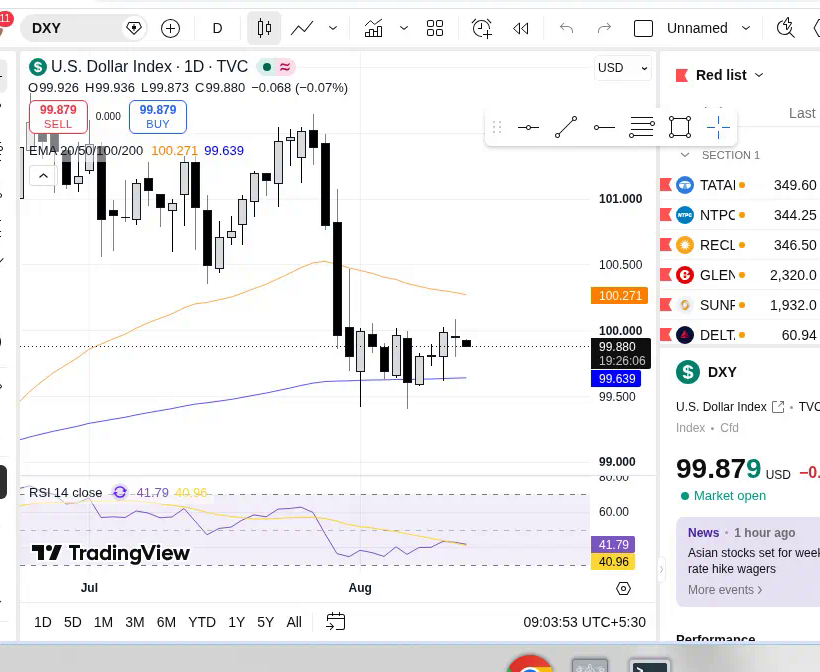
How US CPI affects the dollar was the first filter this week. CPI in line, PPI confirmation, and a slip in September hike odds toward about 35% from about 40% is the sort of inflation pack that argues the Fed can hold in September rather than hike. That is a market read, not a commitment from the Committee.
It is also incomplete. A hold case built only on cooler prices still needs the labour and consumer side not to break. Thursday’s jobless claims printed 209k after a 200k prior — still low. Claims did not hand the Fed a labour shock. Retail Sales and UMich are the next check on whether demand is cooling in a way that would reinforce a hold, or remaining firm in a way that keeps the hike debate alive.
Two Fed voices sketched the tension without handing Friday a number.
Goolsbee said inflation readings are improving, with many factors still coming from tariffs and oil, and that he hopes the trend persists. That is an inflation-path comment: better prints, noisy drivers, no victory lap.
Barkin said the labour market looks vulnerable and that the Fed is not in a forward-guidance place. That is the other mandate: if jobs are the risk, the Committee would rather watch data than pre-commit to September.
Together they describe a data-dependent hold debate. Soft CPI and PPI lean hold. A firm Retail Sales print, or a sentiment rebound that keeps spending expectations intact, would argue the consumer has not rolled over. A clear miss versus consensus would argue the opposite. Neither speaker turned Friday into a signal.
Do not trade a number you do not have. Consensus for Retail Sales and preliminary UMich will be on the economic calendar at the UTC stamp. Compare actual versus consensus versus prior the same way you would for CPI — the method in how to use a forex economic calendar.
A practical US retail sales impact on USD pairs:
UMich is sentiment, not receipts. It can move the dollar when it surprises, but it is a mood check sitting next to the spending print, not a substitute for it. Control group / ex-auto detail, if the wire carries it, is what desks use to sanity-check the headline. If USD jumps and yields do not, the first move is less trustworthy.
Pull Friday’s UTC times and consensus from the economic calendar, then watch the dollar reaction on live prices. For the inflation side already on the tape: US CPI and the dollar.
Informational only. Not trading advice, signals, or a guarantee of any market outcome.
Written and fact-checked with AI assistance, reviewed by a human editor before publication.
No comments yet. Be the first to share your view.
EIA crude inventories drew 0.4M for the week ending September 4, versus a 1.4M draw forecast and a 4.5M prior draw — a smaller-than-expected decline.

WTI jumps toward $97.00 (+2.93%) as US–Iran escalation lifts the supply-risk premium. Reuters: Iran hit 10 ships near Hormuz after the US sank five Iranian tankers; Houthi hits on Saudi energy facilities.

Lagarde says inflation stays well above target into 1H27 and returns around target toward end-2027, with longer-term expectations near 2%. Data-dependent stance; further tightening may follow. Soft ECB print + EUR post-print — PC≠hike reprint.