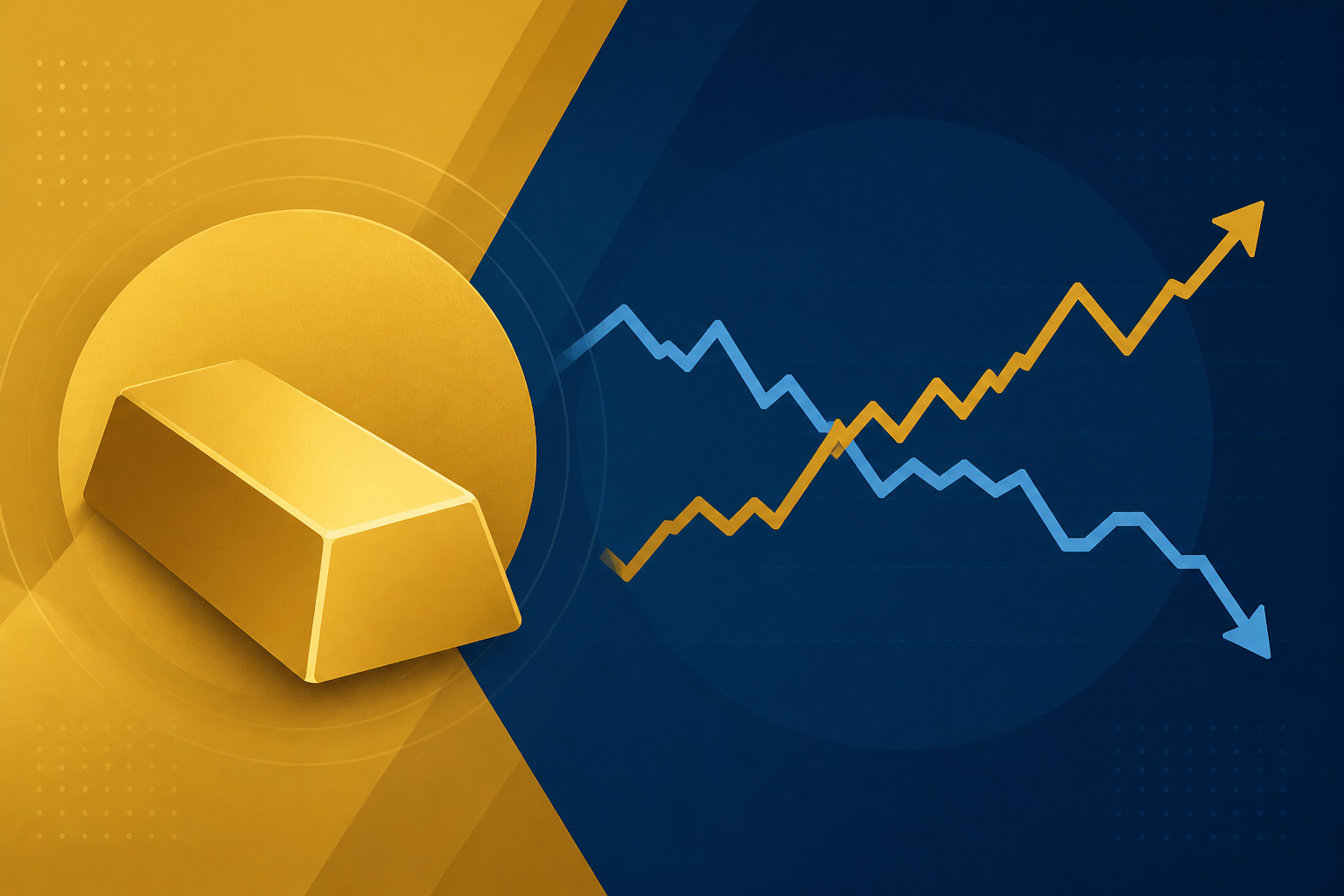
Gold is priced in dollars for most of the market, so a softer greenback often makes an ounce cheaper for buyers using other currencies—and more attractive versus cash and Treasuries. That inverse tendency is common, not guaranteed. The cleaner read usually runs through opportunity cost and real yields, not a mechanical “dollar down, gold up” rule.
Opportunity cost and real yields
Gold pays no coupon. When US rates and inflation-adjusted yields climb, holding cash or bonds becomes more competitive; gold often faces headwinds. When the dollar softens alongside falling real yields (nominal yields minus expected inflation), that opportunity cost shrinks and gold can find a bid.
A weaker dollar and lower real yields often travel together when markets price easier Fed policy or softer US data. That is why many FX and macro desks watch DXY, front-end Treasuries, and inflation expectations in the same frame as XAU/USD—not the dollar print alone.
When the inverse USD–gold link breaks
The relationship is a tendency. It can fail or flip when other drivers dominate:
- Risk-off shocks — Equity stress or geopolitical spikes can lift the dollar and gold if both are treated as havens, or if dollar funding demand surges while gold still attracts safe-haven flows.
- Inflation shocks — A hot CPI/PCE surprise can lift gold as an inflation hedge while the dollar firms on sticky-rate pricing. Both can rise together until the policy path clarifies.
- Dollar moves for non-US reasons — Eurozone or China shocks that reprice EUR or CNY can move DXY without the same US real-yield story that usually maps to gold.
- Positioning and liquidity — Crowded gold longs into a dollar bounce can unwind even if the medium-term rates story still looks gold-friendly.
Treat “why gold rises when the dollar falls” as a default framing—then check whether yields, inflation, or risk are overriding it.
What to watch next
- US inflation and labour prints that shift Fed path and real yields (economic calendar)
- DXY / major USD pairs versus XAU/USD on the same session
- Real yield proxies (e.g. TIPS yields) when dollar and gold diverge
- Risk tone: equities, credit, and haven flows that can break the usual inverse link
Next steps: Track catalysts on the economic calendar, check live gold and prices, and browse more in Gold. US CPI and the Dollar.
FAQ
Does gold always rise when the dollar falls?
No. Inverse USD–gold moves are frequent, especially when real yields move with the dollar, but risk-off, inflation shocks, and positioning can break or reverse the link.
Why do real yields matter more than the dollar alone?
Gold’s main rival is interest-bearing USD cash and bonds. Real yields measure that opportunity cost after inflation; the dollar is often the visible twin of that rates story.
Can gold and the dollar rise at the same time?
Yes. Hot inflation with sticky Fed pricing, or broad haven demand, can lift both until one driver takes over.
What should FX traders monitor alongside DXY for gold?
Calendar data that moves Fed odds, real yields, and risk sentiment—then confirm on the gold and price hubs rather than assuming the inverse correlation will hold.
Informational only — not trading signals or a promise of returns.
Written and fact-checked with AI assistance, reviewed by a human editor before publication.